Your Bill of Entry is stuck. The reason? A single, missing line in a document you didn't even file. Welcome to the world of the Import General Manifest (IGM). For any freight forwarder or customs broker in India, understanding the IGM status is the difference between a smooth clearance and a shipment held up by paperwork you can't directly control. It’s the first critical checkpoint in the customs clearance chain, and getting it right means fewer calls from anxious customers asking, "Where is my container?"
This guide walks you through exactly how to check the IGM status on ICEGATE, what each stage means for your import, and what to do when things go wrong. It’s a core part of the complete guide to proactive shipment tracking, because the best status call is the one that never has to be made.
What the IGM is and Why It Matters
The Import General Manifest (IGM) is the carrier's electronic declaration to Indian Customs of all cargo it is bringing into the country. Checking its status tells you a simple but critical fact: whether your bill of lading or airway bill is correctly listed in the carrier's manifest. Without this, your import clearance process cannot begin.
The Definition of an Import General Manifest (IGM)
The Import General Manifest (IGM), also known as the arrival manifest, is the electronic list of all goods on board a vessel or aircraft arriving in India. According to Section 30 of India’s Customs Act, 1962, the person in charge of the conveyance (the carrier) must file this manifest electronically with Customs before the vessel or aircraft arrives. It is the foundational document that informs Customs what cargo is entering its jurisdiction.
Why IGM Status is Critical for the Bill of Entry
The Bill of Entry (BoE), which is the importer's declaration of goods, is not filed in a vacuum. It must be linked directly to a specific entry in the carrier's IGM. To file a BoE correctly on the ICEGATE portal, the customs broker needs the IGM number, the IGM date, and the specific line (and sometimes sub-line) number corresponding to the shipment. If the IGM status shows the shipment isn't in the manifest, or the details are wrong, the BoE filing will be rejected or mismatched, halting the entire clearance process.
Who Files What: The Three Key Players in the IGM Process
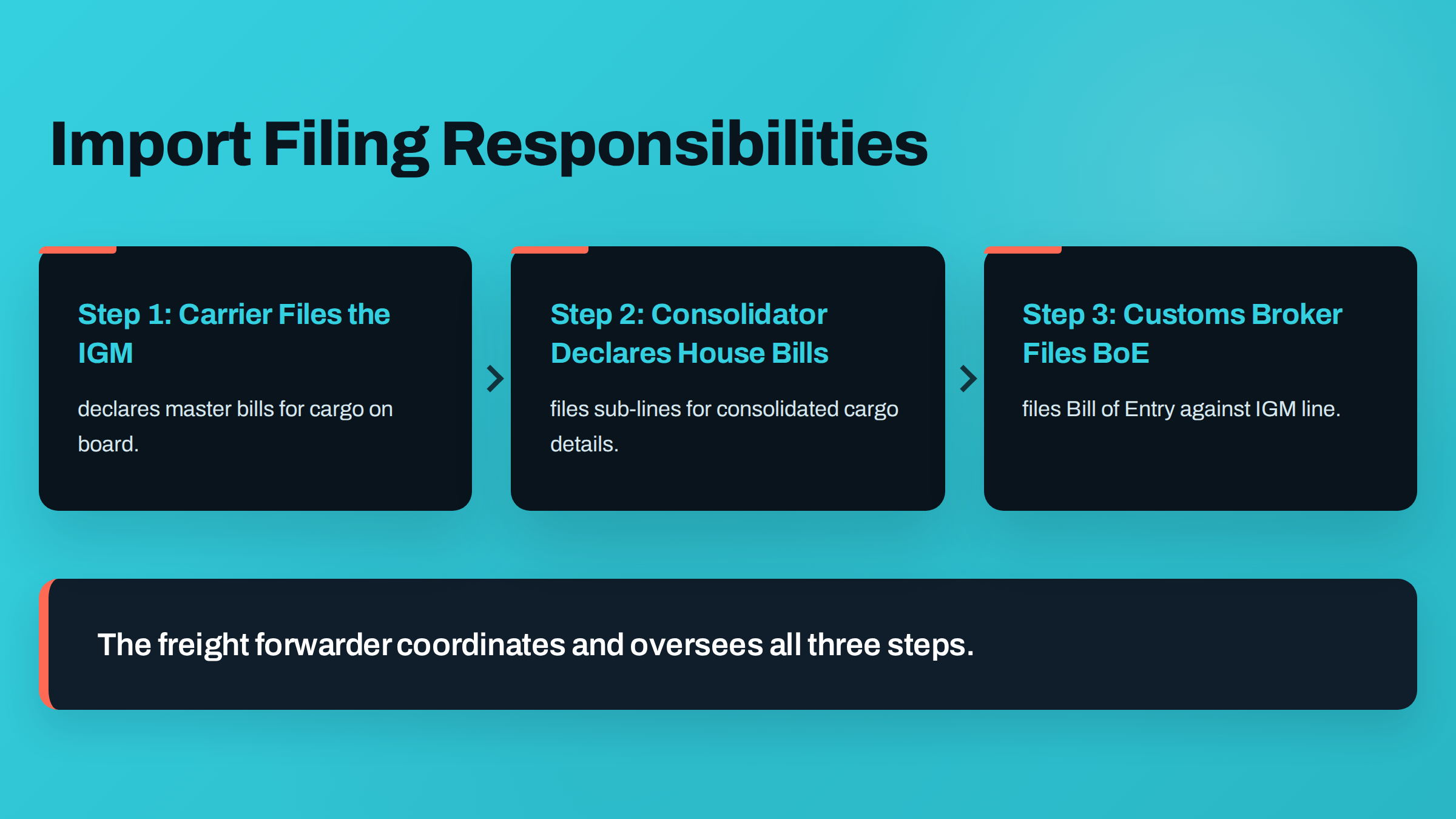
A common point of confusion is who is responsible for each step. The forwarder's job is often to coordinate and chase, but you need to know who to chase. The process involves three distinct parties, each with a specific filing responsibility.
1. The Carrier Files the IGM
The shipping line, airline, or their authorized agent is legally responsible for filing the IGM with Indian Customs. They declare all the Master Bills of Lading (MBL) or Master Air Waybills (MAWB) for the cargo on board. If there is an error in the master-level details—like the consignee name, container number, or port of discharge—it is the carrier's responsibility to file an amendment.
2. The Consolidator Declares House Bills
For consolidated cargo (LCL or air freight consolidations), a consolidator or co-loader is involved. The carrier's IGM will only show the master bill issued to the consolidator. The consolidator is then responsible for filing the House Bill of Lading (HBL) or House Air Waybill (HAWB) details as sub-lines under the corresponding master line. If your house bill is missing from the IGM, the consolidator is the party to contact.
3. The Customs Broker Files the Bill of Entry
Once the IGM is filed and the line number is available, the importer’s customs broker (also known as a Customs House Agent or CHA) files the Bill of Entry. This filing is made *against* the IGM line number. The broker cannot file the BoE if the IGM line doesn't exist or if the details (like package count or weight) don't match what's on the commercial invoice and packing list.
The freight forwarder's role is to watch over these steps, ensuring each party files correctly and on time, and to troubleshoot when a link in the chain breaks.
How to Check IGM Status on ICEGATE: A Step-by-Step Guide
You can check the IGM status for any shipment through the public enquiry services on the ICEGATE portal. The process is straightforward, provided you have the correct information to hand.
What You Need Before You Start
Before you begin your icegate igm status check, make sure you have the following details from the carrier or consolidator:
- The customs location code (e.g., INMAA1 for Chennai Sea, INNSA1 for Nhava Sheva).
- The IGM Number and IGM Date (if already generated).
- Alternatively, the Master Bill of Lading (MBL) or Master Air Waybill (MAWB) number.
The Public Enquiry Process on ICEGATE
Follow these steps to perform an IGM status check:
- Navigate to the official ICEGATE website.
- Open ICEGATE's public enquiry services.
- Choose the IGM enquiry for your mode, sea or air.
- On the enquiry page, select the correct customs Location from the dropdown menu. This is a critical step.
- Enter the details the form asks for, typically the IGM number and date, or the master bill or airway bill number.
- Enter the captcha code and submit your query.
What the Results Show (and What to Do if You Find Nothing)
If successful, the search will return the IGM details, including the line and sub-line information, container details, and the entry inward date. You can confirm if your HBL is listed under the MBL and verify the package count and weight.
If the lookup finds nothing, don't panic. Check the following first:
- Wrong Port Code: Are you searching at INNSA1 when the IGM was filed at a different Nhava Sheva customs location?
- Master vs. House Bill: The public enquiry often works best with the Master B/L number. A search with just the House B/L may not work.
- Incorrect Date: Double-check the IGM date. An off-by-one error is a common reason for a failed search.
- Timing: The manifest may have just been filed and is not yet reflected in the public system.
What Each IGM Status Means for Your Import
The journey from manifest filing to cargo release involves several distinct stages. Understanding the difference between BOE status vs IGM status is key; the IGM is about the carrier's declaration, while the BOE is about the importer's declaration. Here’s what happens after IGM is filed.
Stage 1: Manifest Filed by Carrier
This is the starting point. The carrier submits the manifest to Customs through ICEGATE before arrival. Until the manifest is in the system, a public lookup will find nothing, and the customs broker has nothing to file the Bill of Entry against.
Stage 2: IGM Number and Line Numbers
Once the manifest is in the system, it carries an IGM number and date. Crucially, each bill of lading is given a unique line number, and each house bill under it gets a sub-line number. This is the green light for the customs broker to prepare the Bill of Entry.
Stage 3: Entry Inward Granted
When the vessel or aircraft physically arrives and completes arrival formalities at the Indian port or airport, Customs grants "Entry Inward." Under Section 31 of the Customs Act, 1962, imported goods may not be unloaded until entry inward has been granted. This status confirms the conveyance has officially arrived from a customs perspective.
Stage 4: Bill of Entry Filed Against the Line
With the IGM line number and entry inward confirmed, the customs broker files the Bill of Entry. The BoE status will now be tracked separately, moving through stages like assessment and examination.
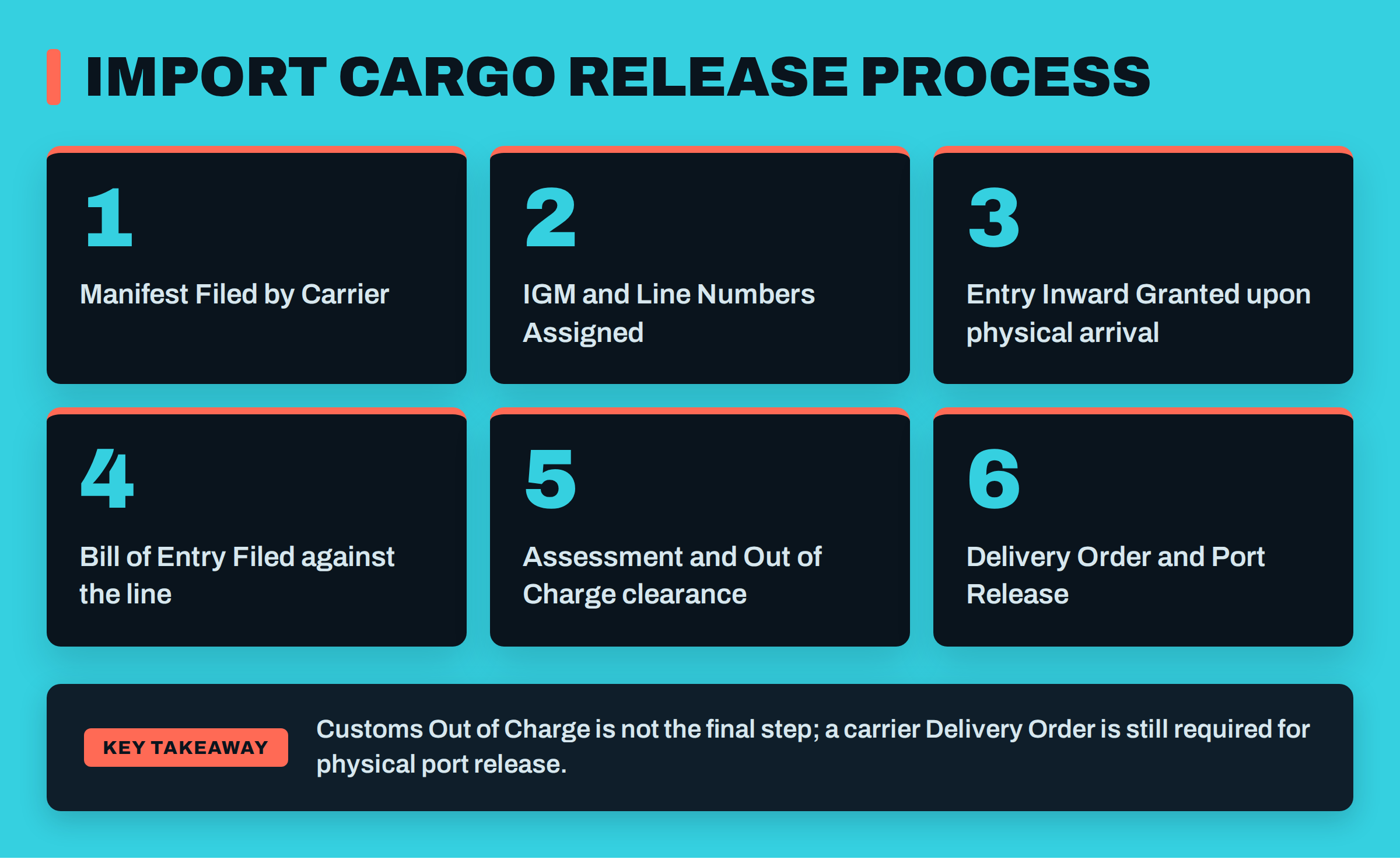
Stage 5: Assessment, Duty Payment, and Out of Charge
After the BoE is filed, it is assessed by a customs officer (or the Risk Management System). Once any queries are resolved and the applicable customs duty is paid, the officer gives the "Out of Charge" (OOC) order. This is the official customs release. It signifies that the goods are cleared from a customs standpoint.
Stage 6: Carrier Delivery Order and Port Release
Out of Charge is not the final step. The importer or their agent must still approach the shipping line or airline to get a Delivery Order (DO). This requires settling any pending freight charges and surrendering the original Bill of Lading (or relying on a telex release or sea waybill). With the OOC and the DO, you can then pay terminal handling and other port charges to finally take delivery of the cargo.
Everyday IGM Problems and What to Do
Even with a clear process, issues are common. Here’s how to handle the most frequent IGM-related headaches.
The Master Line is There, But Your House Bill is Not
This is a classic consolidator issue. It means the shipping line has filed its manifest, but the party who consolidated your cargo has either not filed the house bill details, filed them with an error, or filed them late. Action: Contact the consolidator or co-loader at origin or destination immediately. Provide them with the Master B/L details and ask them to confirm the HBL filing status.
Wrong Port Code or Date in the Lookup
As mentioned, a "no record found" error is often a simple data entry mistake. Before escalating, always double-check that you are using the precise customs location code (e.g., for a specific terminal at Mundra) and the exact IGM date provided by the carrier, not just the vessel ETA.
The IGM is Filed Late by the Line
Carriers are required to file the IGM before arrival, but delays can happen, especially on short-sea routes. This directly impacts your ability to file a timely Bill of Entry, potentially leading to delays and demurrage. A late IGM filing is similar to a delay caused by when cargo gets rolled—it's a carrier-side issue with real consequences for the importer. Action: Contact the carrier's agent, get a reason for the delay, and ask for an estimated filing time. Keep the customer informed that the BoE is on hold pending the carrier's manifest filing.
Manifest Mismatch Needs an Amendment
If the IGM is filed but contains errors (e.g., wrong package count, weight, or consignee details), a manifest amendment is required. This amendment must be filed by the carrier or their agent. The customs broker cannot fix the carrier's manifest. Action: Immediately notify the shipping line's agent of the discrepancy, provide them with the correct details and supporting documents, and monitor the IGM status for the amendment to be approved.
Keeping the Customer Informed
The most stressful part of a forwarder's day is managing customer expectations. Instead of just forwarding cryptic status codes, translate them into plain, meaningful updates.
Which Milestones to Communicate
Focus on the updates that mark a real change in the shipment's status:
- "In the manifest": "Your shipment has been declared to Indian Customs on the carrier's arrival manifest."
- "Entry inward granted": "The vessel has officially arrived and been processed by Customs at the port."
- "Bill of Entry filed": "We have submitted the import declaration to Customs and are awaiting assessment."
- "Out of Charge": "Great news! Customs has cleared your shipment. We are now arranging the final delivery."
After delivery, the final step is securing the proof of delivery to close the loop.
How LogiTrack AI Helps
This is where technology can work alongside your team. Instead of manually checking portals and typing out emails, LogiTrack AI monitors the underlying data sources for you. Our system answers "where is my cargo?" on the customer's own thread, using data from carrier status and, through FreighAI, from India's ULIP platform. It then drafts a clear, human-readable update. Crucially, every message a customer sees waits for a person, who can edit, approve or reject it. An approved message goes out in your own name, ensuring you are always in control of communication.
LogiTrack AI does not file anything with Customs. It is your team's watchful assistant, drafting the right update at the right time so you can focus on solving problems, not just reporting them. The goal is to make the status call obsolete because the customer already has the answer.
The aim is simple: the customer has the update before they think to ask. To see how it works, watch an exception caught.
Frequently Asked Questions
Who files the IGM in India?
The Import General Manifest (IGM) is filed by the carrier—that is, the shipping line, airline, or their authorized agent. This is a legal requirement under Section 30 of the Customs Act, 1962. The freight forwarder or customs broker does not file the IGM; they use the information in the filed IGM to perform subsequent steps like filing the Bill of Entry.
What is the difference between IGM and Bill of Entry?
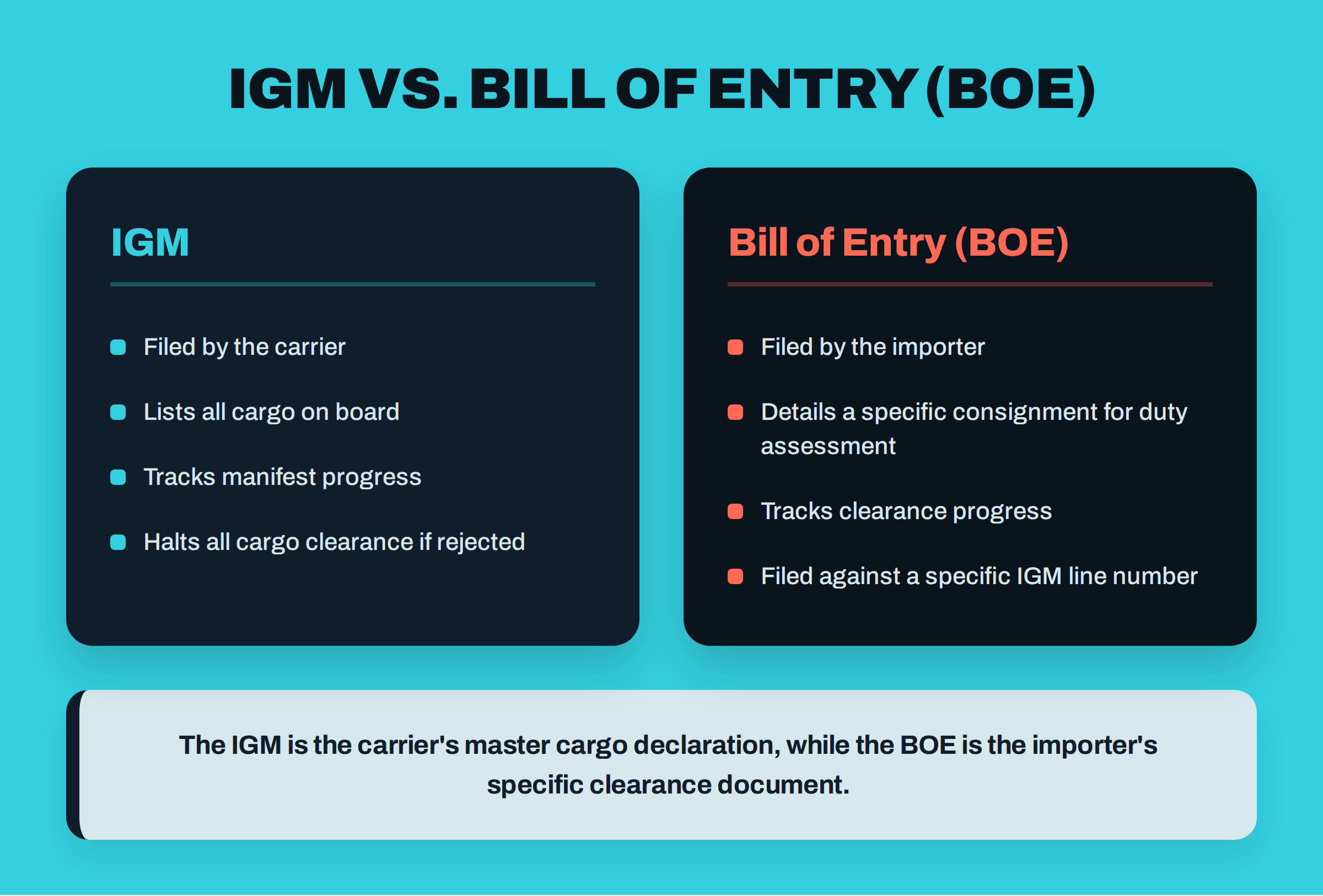
The IGM and the Bill of Entry (BoE) are two distinct declarations for two different purposes. The IGM is the carrier's declaration to Customs, listing all cargo on board a conveyance. The BoE is the importer's declaration to Customs, detailing a specific consignment for clearance, classifying the goods, and assessing duty. The BoE is filed against a specific line item in the IGM.
What is an IGM line number?
An IGM line number is a unique serial number assigned to each individual Bill of Lading or Air Waybill within an Import General Manifest. For consolidated shipments, a House Bill of Lading may be assigned a "sub-line number" under the master bill's line number. This number is essential for the customs broker to correctly link the Bill of Entry to the specific shipment in the customs system.
What is the difference between IGM status and BOE status?
IGM status tracks the progress of the carrier's manifest declaration (whether it has been filed, and whether its lines are correct or have been amended). It tells you if the cargo is properly declared to Customs upon arrival. BOE status tracks the progress of the importer's customs clearance declaration (e.g., filed, assessed, examined, out of charge). You can have an accepted IGM but a pending or rejected BOE, or vice-versa, which is why both must be tracked.
What happens if my IGM is rejected?
If an IGM is rejected by Customs, it is usually due to data errors or non-compliance with the specified format. The carrier or their agent will receive an error code or rejection message from the ICEGATE system. They are responsible for correcting the errors and resubmitting the manifest. A rejected IGM will prevent the filing of any Bills of Entry against it, effectively halting clearance for all cargo on the manifest until it is corrected and accepted.
Where can I read more about ICEGATE filing?
For a deeper look into the various electronic filing processes on the ICEGATE portal, including Bills of Entry and Shipping Bills, you can refer to our comprehensive guide here: https://www.freigh.ai/guides/india-icegate-filing.
Sources & References
This article draws on research and data from the following verified sources:
Put the watch on your boxes.
Everything on this page runs live in a working tracking desk. Bring ten shipments on the water and watch the updates land before the questions do.
Book the working sessionKEEP READING