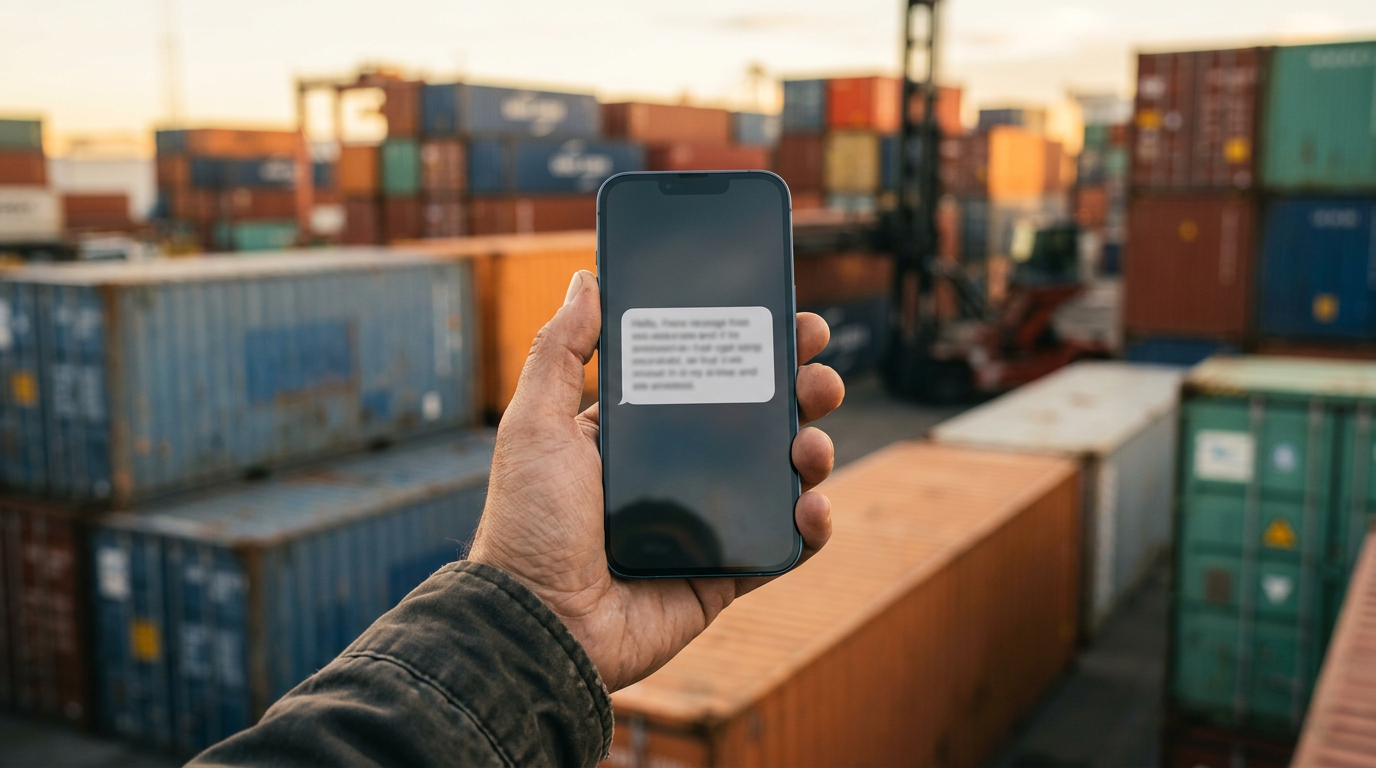
The question “where is my container?” is freight’s version of retail’s WISMO, or “where is my order?” It is the sound of a customer who lacks a clear status. For a freight forwarder, every such call or email means a coordinator stops their work, opens a carrier or port website, finds the shipment, interprets the event trail, and types a reply. The cheapest status call is the one nobody has to make.
Forwarders stop these calls by sending each milestone and exception to the customer before they think to ask. The update arrives on the customer’s own thread, is approved by a person, and explains what happens next. This article explains what status questions cost, why they keep coming, and how to answer them in advance. For a detailed walkthrough, see the complete guide to proactive shipment updates. Or, to put a number on the time your team spends, work out what status calls cost your team.
What one status question costs
Answering a single status question is rarely a one-click task. It is a manual process that pulls an operations coordinator away from managing exceptions, arranging deliveries, or clearing customs. While no published freight industry figure exists for time spent on status calls, the steps are consistent across most desks.
The manual steps behind each answer
A typical response to “where is my container?” involves several steps:
- Find the right system: The coordinator opens the relevant carrier, port, or terminal website. According to Maersk, tracking requires a bill of lading or container number.
- Key in the reference: The coordinator enters the number, which may first need to be looked up in the forwarder’s own system.
- Read the event trail: The portal returns a list of events like “gate-in,” “loaded on vessel,” or “discharged.” This is raw data, not a customer-ready answer.
- Interpret the status: The coordinator must work out what the event means. “Discharged” at Jebel Ali or Felixstowe does not mean “ready for pickup.” The container could be awaiting customs release or a terminal appointment.
- Formulate and send a reply: Finally, the coordinator types an email or message explaining the status, the next step, and the new estimated time of arrival (ETA) if it has changed.
A worked example of time spent
The following is an illustration using assumed numbers. It is not an industry benchmark.
A desk that answers 40 status questions a day at 6 minutes each spends 240 minutes, or 4 hours, just on these lookups. Over 22 working days, that is 88 hours a month—more than two full work weeks spent on information the forwarder could have sent first.
This simple arithmetic only accounts for the time spent answering. It excludes the cost of interruptions, escalations, and the delayed progress on other important tasks. You can swap in your own numbers and work out what status calls cost your team.
Why the questions keep coming
Customers ask “where is my container?” because silence reads as a problem. When a shipment passes its expected departure or arrival date with no update, the customer assumes something has gone wrong. Given the state of global shipping, their concern is often justified.
The events that trigger most questions
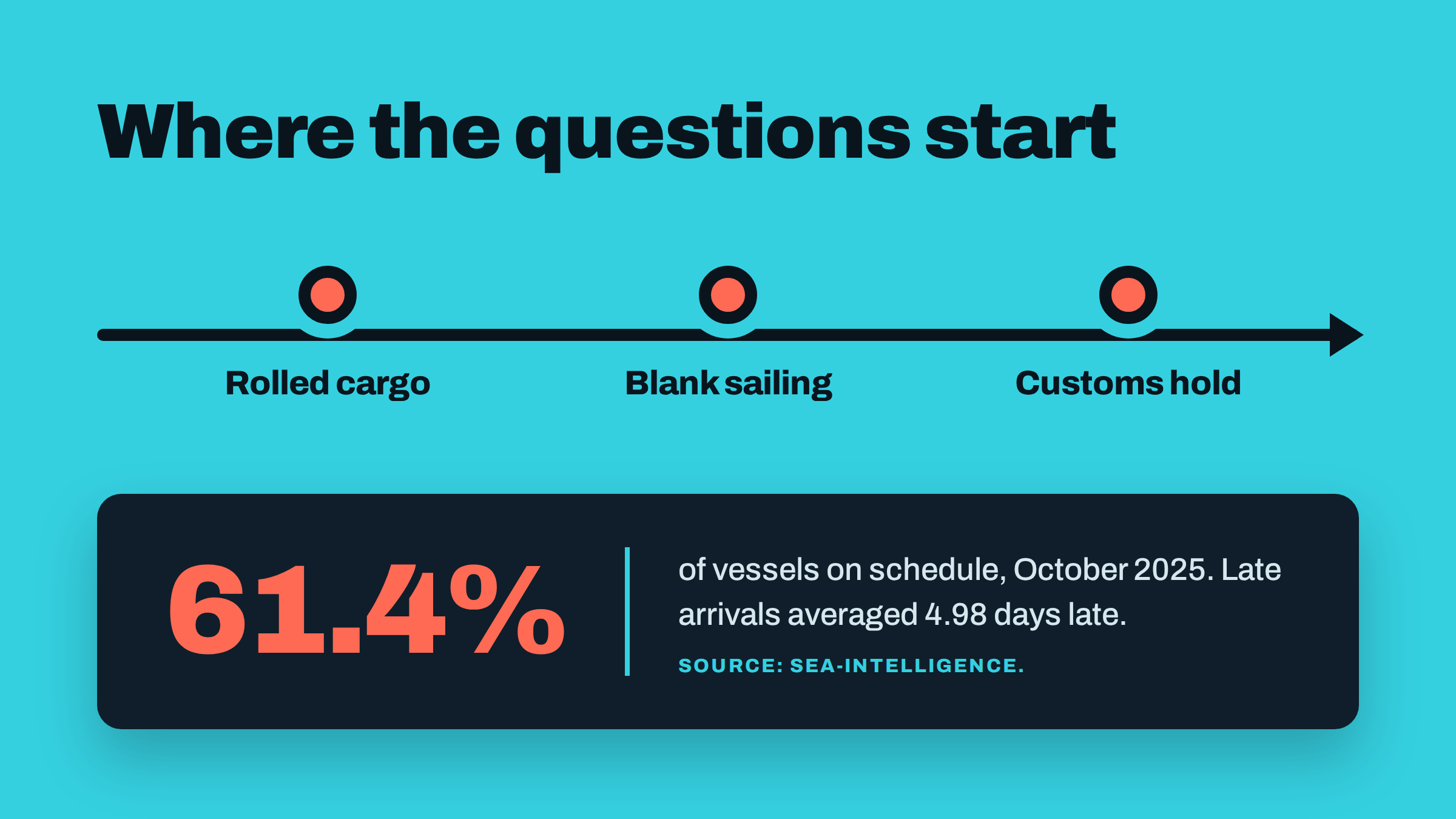
Most questions cluster around a few key points in a shipment’s journey: departure, transshipment, and arrival. The uncertainty is magnified by exceptions that carriers do not always announce clearly.
- Rolled cargo: The container was not loaded on its planned vessel and has been moved to a later sailing. This is a common occurrence that can delay a shipment by days or weeks. You can learn more about what happens when cargo gets rolled and how to manage it.
- Blank sailing: The carrier cancels an entire scheduled sailing, often due to demand fluctuations or to recover a vessel’s schedule.
- Customs holds: A container can be physically at the port of Los Angeles/Long Beach or Nhava Sheva but unavailable for pickup due to a documentation query or physical inspection by customs authorities.
- ETA changes: A vessel’s ETA is an estimate. It can and does change due to weather, port congestion, or operational delays. According to Sea-Intelligence, global schedule reliability was 61.4% in October 2025, with late vessels arriving an average of 4.98 days behind schedule.
Each customer may only ask once per shipment, but an operations desk hears the same question many times a day as multiple shipments encounter the same delays.
What customers now expect
Shipper expectations have evolved. A booking confirmation followed by silence is no longer enough. The demand for digital access and proactive communication has become a key factor in selecting a logistics partner.
The rising importance of customer experience technology
A July 2024 survey from FreightWaves, conducted with the visibility vendor Logixboard, highlights this shift. According to the report, 52% of shippers said they had stopped working with a logistics provider because they were not satisfied with its customer experience technology, such as digital tracking and visibility tools.
From manual updates to self-service visibility
It points to what customers now look for:
- Self-service tracking: The ability to find a shipment’s status on their own.
- Proactive alerts: Notifications for key milestones and, more importantly, for exceptions.
- A single source of truth: A consistent view of all their shipments, regardless of the underlying carrier or mode of transport.
Meeting this expectation is not about replacing human service. It is about freeing up your team to solve real problems by taking the routine lookups off them.
How to stop the calls before they start
Stopping the calls means answering the question before it is asked. This requires a shift from a reactive to a proactive communication strategy. The goal is to send the milestone, and especially the exception, before the customer notices a problem.
Decide which milestones to communicate
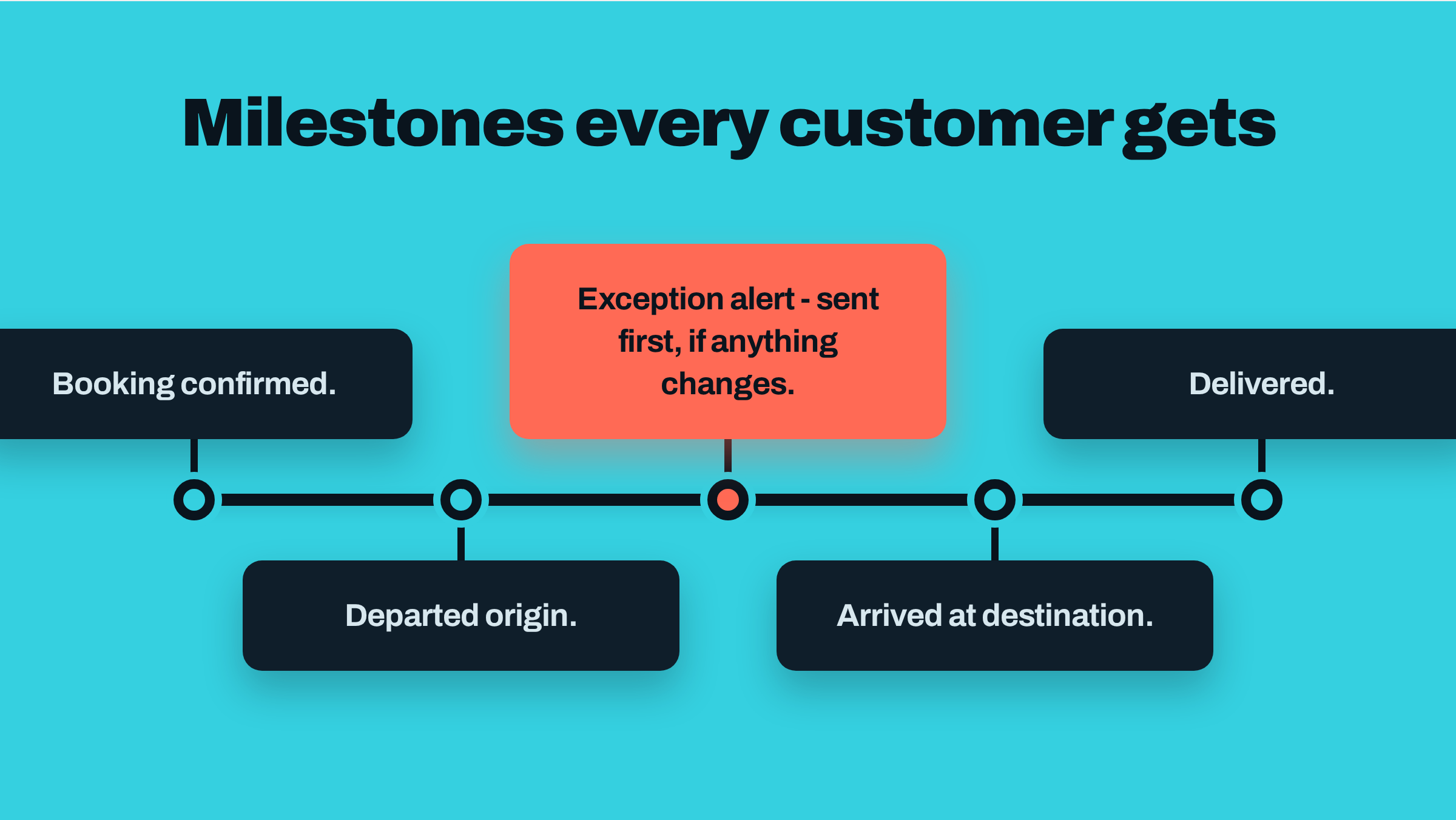
First, establish a standard set of milestones that every customer receives. This ensures consistency. A good baseline includes:
- Booking Confirmed
- Cargo Received at Origin
- Departed Origin (Vessel or Flight)
- Arrived at Transshipment Port
- Departed Transshipment Port
- Arrived at Destination
- Customs Status Update (e.g., Cleared, Held)
- Available for Pickup
- Delivered
You can also offer more detailed updates for customers who want them, but this core list covers the points where most questions arise.
Send exceptions first and fast
A rollover or customs hold that you report early is a service. The same information discovered by the customer is a service failure. Create a workflow where exceptions are the highest priority for communication. A prompt alert about a delay gives your customer time to adjust their own plans, manage their inventory, and inform their end-customer.
Re-baseline the ETA and explain the change
When a ship’s ETA moves, don't just note the new date. Your update should explicitly state that the ETA has been revised, what the old ETA was, what the new one is, and why it changed (if known). This prevents confusion from multiple, conflicting dates in an email chain and sets a new, clear expectation.
Keep updates on the customer's thread
Context is critical. Send updates on the customer’s existing email or messaging thread for that shipment. A new, subject-less email for every update creates noise and makes it harder for the customer to follow the shipment’s story. The message should be in plain words, state what happened, what it means for the delivery, and what happens next. This is a key difference between a tracking desk compared with a visibility platform that integrates communication.
Where LogiTrack AI fits
LogiTrack AI takes on the watching and drafting in this playbook. It works alongside your team to watch every shipment, identify the events that matter, and prepare the right message for the customer.
How it turns data into answers
LogiTrack AI watches every shipment. It classifies the exceptions that carriers often don’t announce, such as rollovers, blank sailings, and customs holds. When an ETA moves, it re-baselines the schedule and drafts a customer update before anyone has to ask “where is my container?”
Human approval on every message
Crucially, LogiTrack AI answers "where is my cargo?" on the customer's own thread, from carrier status, for approval. Automation runs the tracking checks, but every message a customer sees waits for a person on your team. Your coordinator can edit, approve, or reject the drafted update, ensuring it has the right context and tone. The approved message goes out in their own name, preserving your company’s relationship with the customer.
The delivery milestone triggers the final customer update, and the proof of delivery (POD) chase runs on its own. This systematic approach ensures nothing is missed. To see this process in action, you can learn how the desk works.

By handling the repetitive work of tracking and drafting, LogiTrack AI frees your operations team to focus on solving problems and delivering high-value service. The most useful status update is the one you send before the customer even thinks to ask “where is my container?”
Ready to see how it works on a live exception? Watch an exception caught.
Frequently Asked Questions
What does WISMO mean in freight?
WISMO stands for "Where Is My Order?" It is a term from the retail and e-commerce industries for customer inquiries about their order status. In freight, the equivalent is "where is my container?" or "where is my cargo?" It represents any customer query about the location, status, or ETA of their shipment.
How do I find where my container is?
You can typically find a container's location by using the carrier's public track-and-trace website with the container number, booking number, or bill of lading number. However, your freight forwarder should be your primary source of information. A good forwarder provides proactive shipment updates, including key milestones and exceptions like delays or customs holds, so you don't have to search for the status yourself.
Why do customers keep asking for status updates?
Customers ask for status updates for three main reasons. First, silence from their forwarder makes them assume there is a problem. Second, they are impacted by exceptions like rolled cargo, blank sailings, or customs holds and find out about them late. Third, estimated times of arrival (ETAs) often change without notice, leaving them unsure of the real delivery date.
Should status updates go out automatically?
The tracking and detection part of the process can and should be automated. Systems can run tracking checks on their own to monitor for new milestones or exceptions. However, every message a customer sees should be reviewed and approved by a person. This human-in-the-loop approach ensures that the update is accurate, has the correct commercial context, and maintains the forwarder's relationship with the customer. Fully automated, unreviewed messages risk sending confusing or incorrect information.
What is the difference between a carrier portal and a forwarder's tracking system?
A carrier portal provides tracking data for shipments handled by that specific carrier. A freight forwarder's tracking system, like LogiTrack AI, brings the forwarder’s shipments across carriers into one view. It translates raw operational events (e.g., "gate-out") into meaningful customer updates (e.g., "Your container has left the port and is on its way to the warehouse") and flags the exceptions that need a person.
What are the most important shipment milestones to communicate?
While every shipment is different, the most critical milestones to communicate are those that mark a major transition or a change in plan. These include: Booking Confirmed, Departed Origin, Arrived at Destination, Customs Cleared, and Delivered. Even more important are exception alerts for events like Rolled Cargo, Blank Sailing, Customs Hold, or any significant change to the Estimated Time of Arrival (ETA).
Sources & References
This article draws on research and data from the following verified sources:
Put the watch on your boxes.
Everything on this page runs live in a working tracking desk. Bring ten shipments on the water and watch the updates land before the questions do.
Book the working sessionKEEP READING